Email Us :
info@labcompanion.cn
-

-

Requesting a Call :
+86 18688888286

Lab space is always at a premium in laboratories. Vertical thermal cycling chambers take up substantial floor space, while test specimens at the R&D stage are often just a handful of chips and small modules. This is where benchtop models stand out: compact footprint, user-friendly operation and single-operator manageability, allowing engineers to run validation tests conveniently on demand.
A common misconception treats benchtop chambers as scaled-down units with compromised accuracy. In fact, temperature performance depends on engineering design rather than chamber size. For benchtop TC chambers, small specimens feature low thermal mass, so temperature fluctuations transmit directly to the DUTs. Consequently, they demand no less precise temperature control than large-format chambers. Rooted in Dongguan, Lab Companion has specialized in environmental reliability test equipment for over two decades. Our benchtop TC thermal cycling chambers combine compact footprint and high precision to support laboratory validation. This article covers application boundaries, temperature control principles and selection guidance.
Benchtop chambers feature compact internal cavities, ideal for chips, mini modules, electronic components and test coupons. Specimens are normally loaded on racks or trays with limited batch capacity. They are designed primarily for R&D validation instead of mass production screening.
Understanding this boundary is critical. Deploying benchtop units for high-volume sampling leads to frequent reloading and low throughput. Conversely, using large chambers for small-batch testing wastes power and valuable lab space.
Benchtop models support a wide temperature envelope and multiple ramp rates. Standard Lab Companion benchtop TC chambers cover -70℃ to +150℃, with selectable rates of 5℃/min, 10℃/min and 15℃/min, meeting most standard thermal cycling requirements for laboratory testing.
Small cavities deliver fast, responsive temperature transitions. However, internal airflow is easily disturbed by specimen arrangement. Improper loading may introduce localized temperature deviations.
Benchtop units are ergonomically sized for workbench placement, with easy door access and intuitive control interfaces. Engineers can configure and launch tests quickly between development tasks. This agility enables frequent trial runs and accelerates iterative development — an often-underestimated advantage for R&D teams.
Large specimens have high thermal mass that naturally dampens cavity temperature variations. Small specimens possess minimal thermal inertia and closely follow every temperature shift inside the chamber. Identical temperature fluctuations create far greater impact on miniature DUTs.
Thermal cycling relies on specimens following a defined temperature profile. Uncontrolled cavity noise distorts the actual temperature profile experienced by samples. In short-cycle, high-loop reliability tests, such deviations accumulate and compromise pass/fail decisions.
A compact chamber does not guarantee inherent temperature uniformity. Airflow channels are easily blocked by specimens. DUTs placed near air outlets or inner walls are prone to hot/cold spots. Proper specimen layout and full-load uniformity verification remain essential for benchtop systems.
The performance benchmark for a benchtop chamber lies in temperature fluctuation, deviation and uniformity — not its footprint. Accepting looser accuracy simply because the unit is small undermines the reliability of test results.
Standard models span -70℃ to +150℃. One single benchtop unit covers multiple thermal conditions, eliminating the need for separate chambers for different temperature zones and optimizing lab capital investment.
Temperature fluctuation ≤ ±0.3℃ and temperature deviation ≤ ±2℃. Stable thermal conditions inside the small cavity ensure the specimen temperature profile closely matches programmed settings for trustworthy reliability results.
5℃/min, 10℃/min and 15℃/min ramp rates are available with multi-segment programmable profiles to replicate industry standards or custom R&D sequences. Engineers can rapidly switch test conditions to compare failure behaviours under different thermal rates and speed up design iteration.
Continuous recording of temperature curves and test data supports traceability and post-test review. Customization is available for cavity size, ramp speed, temperature range and communication interfaces to fit unique lab layouts and automation requirements.
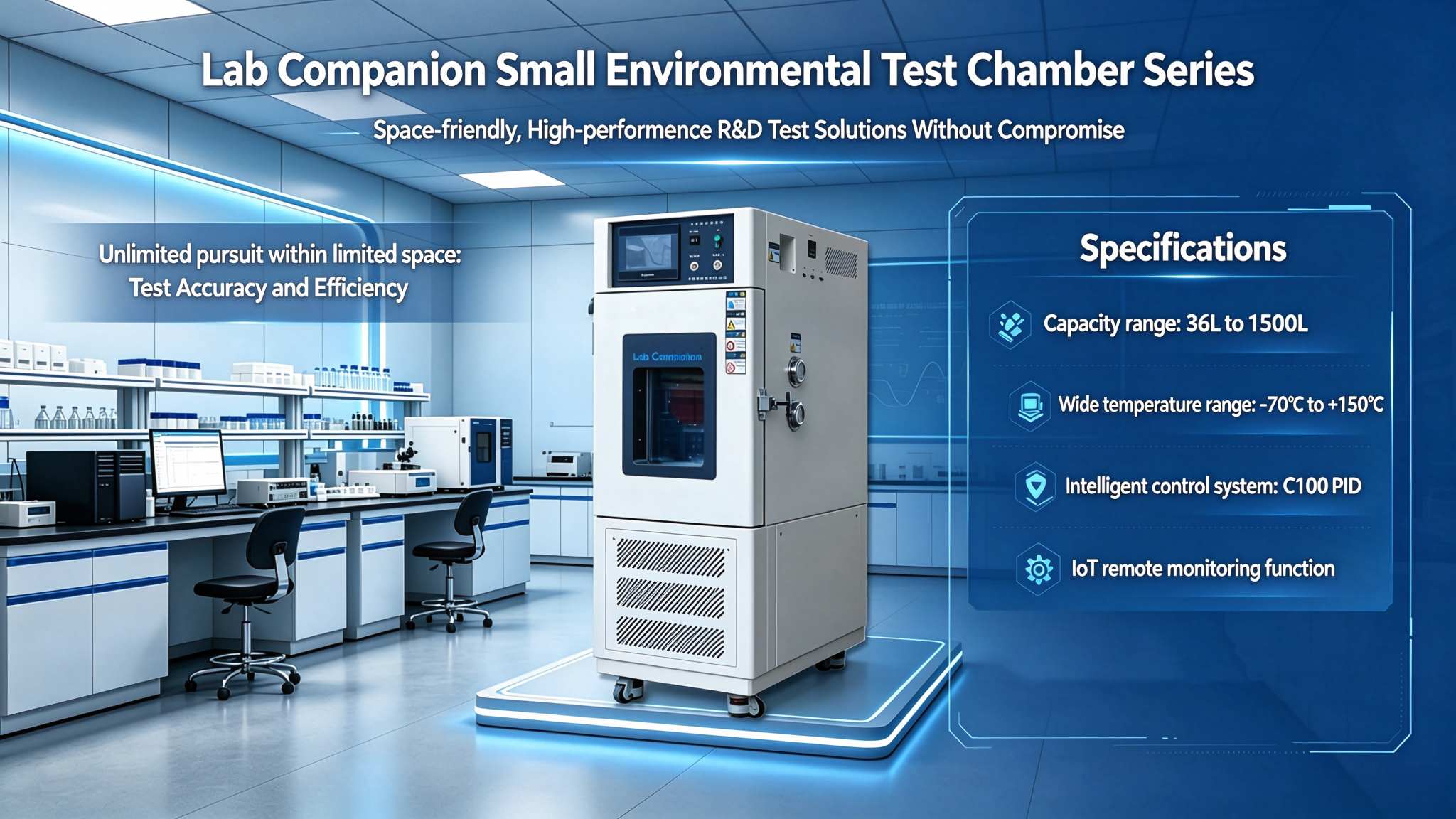
Choose benchtop chambers for R&D validation, low specimen volume and frequent test condition changes. Select vertical or larger chambers for mass sampling, high throughput and multi-layer loading. Clear requirement definition avoids redundant procurement and idle assets.
When evaluating benchtop chambers, prioritize fluctuation, deviation and full-load uniformity. Request measured profiles with your actual DUTs rather than relying solely on empty-chamber datasheet values.
Avoid overcrowding the cavity. Do not place DUTs directly against air outlets or chamber walls. Custom specimen racks can be supplied to optimize layout and maintain smooth airflow.
Benchtop chambers are cycled frequently with repeated start-stop operations, making long-term stability critical. Lab Companion operates three manufacturing bases in Dongguan, Kunshan and Chongqing, with over 6,000 ㎡ production space and an annual output of around 2,000 environmental test systems, backed by a robust after-sales service network.
Chamber size should never be an excuse to compromise temperature accuracy. For chips and miniature components, stable thermal conditions deliver more value than extra cavity volume. Lab Companion benchtop TC thermal cycling chambers combine wide temperature range, high precision and programmable control, enabling reliable reliability validation within limited lab space. We will continue advancing environmental reliability testing technology to support fast R&D iteration for our global partners.
 Get A Quote


 IPv6 network supported